Toronto homeowners comparing landscape lighting systems almost always end up at the same fork: low voltage wired LED versus solar. Both light up a yard. Beyond that, they are fundamentally different products, and choosing the wrong one for a GTA property is an expensive mistake to undo.
This guide breaks down how each system works, where each one performs well, and where the Canadian climate makes the decision for you.
How Low Voltage Landscape Lighting Work
Low voltage systems run on 12-volt DC power, stepped down from your home’s standard 120-volt supply through a transformer installed near your electrical panel or an outdoor outlet. Wire runs from the transformer through the yard, connecting each fixture along the path.
The fixtures themselves are purpose-built LED units designed for permanent outdoor installation. A quality transformer includes a timer and photocell so the system turns on at dusk and off at dawn without any manual input. Because the power source is your home’s electrical supply, brightness is consistent every night, regardless of weather or season.
Professional landscape lighting installation by a trained contractor takes roughly one day for a mid-size residential property in Mississauga or Oakville. The wire is buried or tucked under mulch, fixtures are staked or mounted at pre-planned positions, and the transformer is programmed before the crew leaves.
Book a free landscape lighting consultation at bdlights.ca
How Solar Landscape Lighting Works
Solar fixtures contain a small photovoltaic panel, usually mounted on top of the unit, a rechargeable battery, and an LED. They charge during daylight hours and discharge at night. No wiring. No transformer. No electrician required.
The appeal is obvious: pull them out of the box, stake them in the ground, done. For a rental property, a temporary installation, or a low-priority area of the yard, that simplicity has real value.
The problem is what happens next.
Why Solar Underperforms in the GTA Climate
Ontario’s climate is genuinely difficult for solar landscape lighting, and this is not a marketing claim, it is physics.
Solar panels need direct sunlight to charge effectively. Toronto averages roughly 2,000 hours of sunshine annually, which sounds reasonable until you factor in that most of that light lands in summer months when days are long and sun angles are high. From November through March, the sun sits low in the sky, days are short, and cloud cover is frequent. A solar fixture that runs at full brightness in July may only manage 40 to 60 percent output by December, and less in a week of overcast weather.
Battery degradation is the second issue. Most consumer-grade solar landscape lights use lithium or NiMH batteries rated for 500 to 800 charge cycles. At one cycle per day, that is 18 to 26 months before battery capacity drops enough to affect run time. By year two, many solar fixtures in Vaughan or Brampton yards are dimming noticeably before midnight.
Snow and ice are the third factor. A panel buried under two centimetres of snow generates nothing. In a GTA winter, that can mean consecutive nights of inadequate charge with no performance recovery until the panel is manually cleared. Low voltage systems are indifferent to snow.
Where Solar Landscape Lighting Actually Makes Sense
To be fair to solar: there are specific use cases where it is the right call, even in Toronto.
Remote areas without wiring access. If you have a back corner of a large lot, a detached garage, or a garden shed that sits 50 metres from the house, running wire to that location is a significant cost. A solar accent light in that spot is a reasonable solution.
Low-priority decorative zones. A pathway through a seasonal garden, a flagpole accent, a small water feature, these areas do not require consistent, high-output illumination. If the light is on most nights and looks good most of the time, solar is adequate.
Temporary or rental properties. If you do not want to invest in permanent infrastructure, solar allows you to add exterior lighting without committing to a wired system.
If the area matters to you aesthetically, functionally, or from a security standpoint, solar is not the right tool.
Want to see how a low voltage system would work on your property? Book a free consultation at bdlights.ca
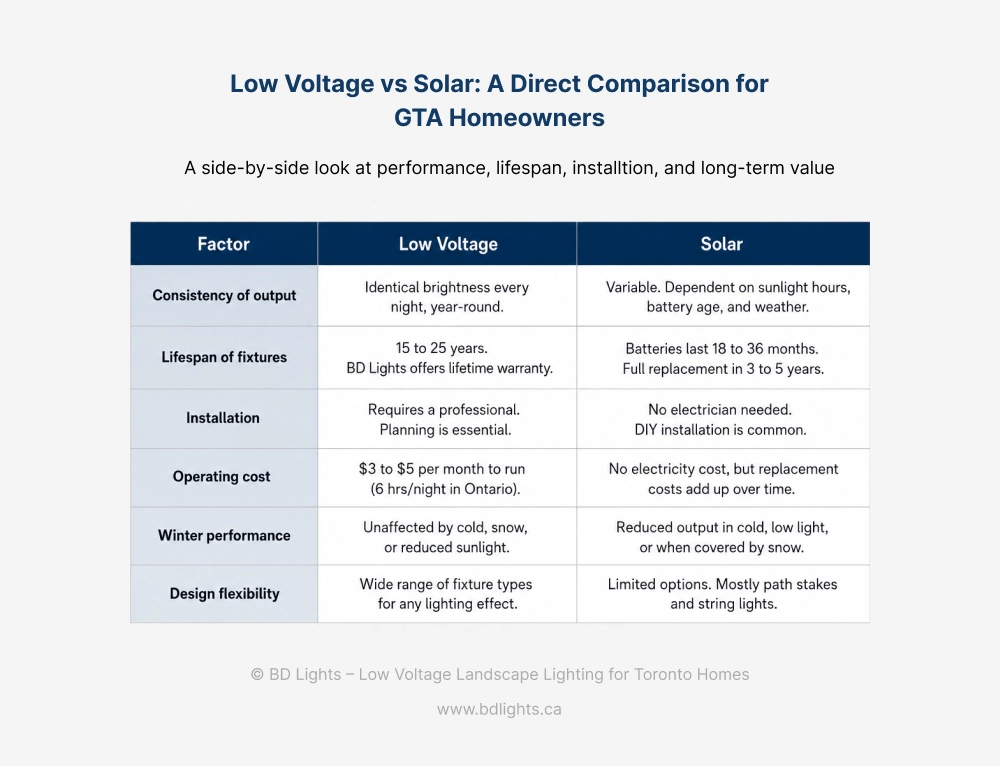
Low Voltage vs Solar: A Direct Comparison for GTA Homeowners
The Real Cost Comparison Over 10 Years
This is where many homeowners get the solar calculation wrong.
A basic solar path light kit, 8 to 10 fixtures, costs between $80 and $200 at a home improvement store. That looks inexpensive compared to a professionally installed low voltage system.
But consider: solar batteries require replacement at roughly the 2-year mark, and full fixture replacement is common at years 3 to 5 as panels degrade. Over 10 years, many homeowners replace their solar fixtures twice, sometimes three times. The cumulative spend on a 10-fixture solar installation often lands between $400 and $700, not including the time and frustration of annual maintenance.
A professionally installed low voltage landscape lighting system in Oakville or Markham, sized for 10 to 15 fixtures with a quality transformer and commercial-grade LED fixtures, carries an upfront cost but runs reliably for 15 or more years. The math changes substantially when you account for time horizon.
If you want to understand what a low voltage system costs for your specific property, request a free consultation at bdlights.ca. BD Lights serves Toronto, Mississauga, Vaughan, Oakville, Burlington, Brampton, and Markham.
FAQ
Is low voltage landscape lighting difficult to maintain? No. A properly installed low voltage system requires almost no ongoing maintenance. Fixture bulbs in LED systems last 50,000 hours or more, which at 6 hours per night is over 20 years. The transformer timer may need seasonal adjustment, and connections should be checked every few years, but most homeowners go years without touching the system.
Can I convert my existing solar lights to a low voltage system? Solar fixtures are not designed to be wired into a low voltage system. When homeowners switch from solar to low voltage, the solar fixtures are replaced entirely. The wire runs, transformer, and new fixtures are all part of the new installation.
How long does low voltage landscape lighting installation take in the GTA? For a typical residential property in Toronto or surrounding cities, installation takes one full day. Larger properties or complex designs may require two days. BD Lights handles all wire routing, transformer programming, and fixture placement.
Does low voltage landscape lighting work in Canadian winters? Yes. Low voltage systems are powered by your home’s electrical supply and are not affected by cold temperatures, snow, or reduced sunlight. Quality fixtures rated for Canadian climates perform identically in January as in July. BD Lights specifies only winter-rated fixtures for all GTA installations.